
The question used to be whether artificial intelligence would change our jobs.
In 2026, that debate feels almost outdated.
AI is already writing reports, reviewing documents, generating videos, answering customer questions and helping software developers produce code. Tasks that once took an employee an afternoon can sometimes be completed in minutes.
For workers, students and parents advising their children, a more uncomfortable question has emerged:
Which careers are actually worth pursuing in the age of AI?
The answer is not as simple as dividing the economy into jobs that are “safe” and jobs that will disappear.
AI rarely arrives at a company on Monday and removes an entire profession by Friday. Instead, it begins consuming tasks. First the repetitive work. Then the predictable work. Eventually, the job itself may be redesigned.
That means the most resilient careers of the future may not be those that completely avoid artificial intelligence.
They will be the careers where human responsibility, physical ability, trust, judgment and relationships remain difficult to automate.
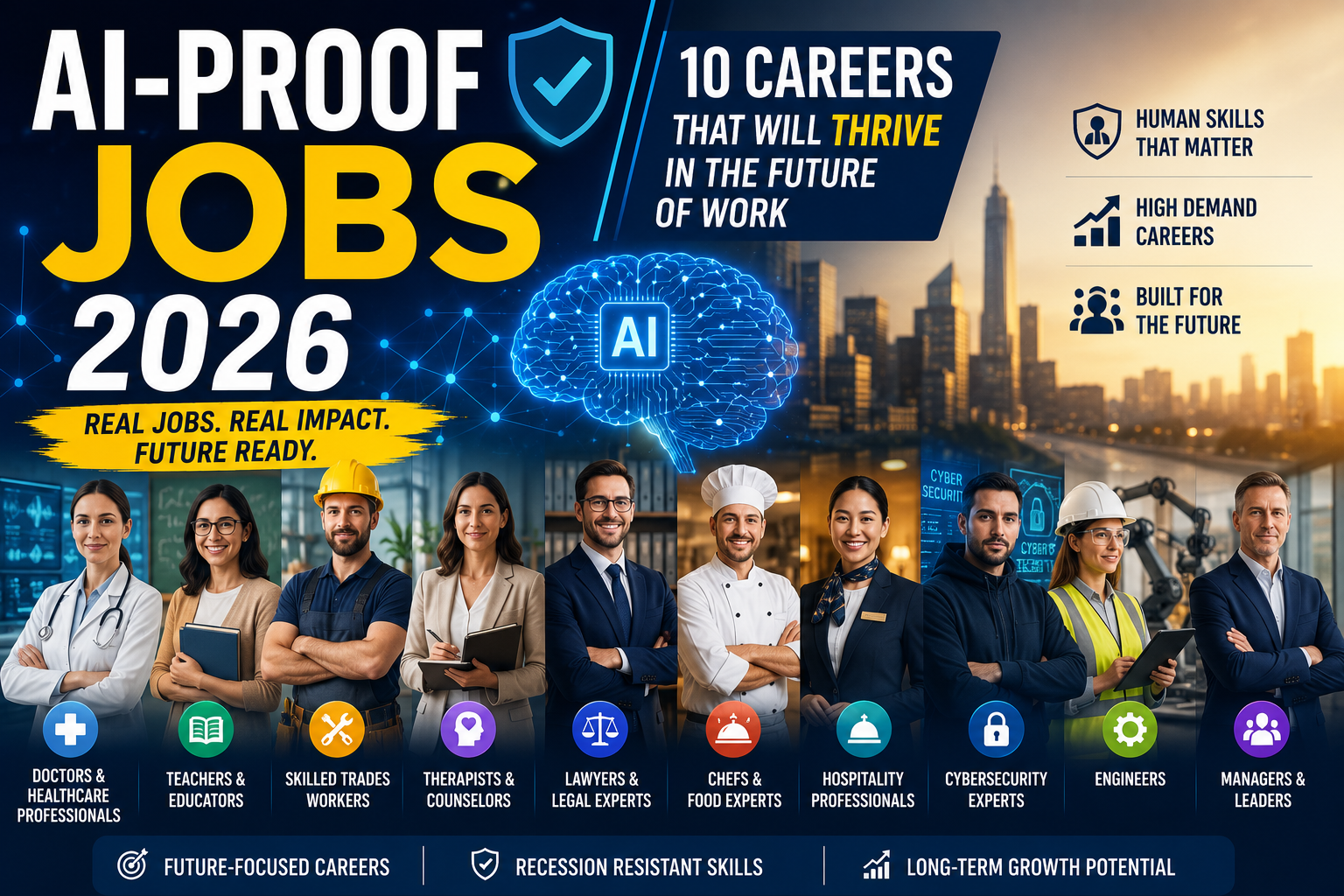
Here are 10 career areas that could remain valuable as the future of work changes.

Is Any Job Really Safe From AI?
Probably not in the absolute sense.
The phrase “AI-proof job” makes a good headline, but almost every major industry will use artificial intelligence in some form.
Doctors are using AI-assisted systems.
Teachers are experimenting with AI tools.
Law firms are integrating generative AI into research workflows.
Hotels are automating administrative tasks.
Even skilled trades are becoming more digital.
The better question is this:
Which jobs become more valuable when AI handles routine tasks?
A useful way to think about career resilience is to look for five human advantages: physical presence, accountability, complex judgment, genuine relationships and unpredictable real-world environments.
The more a career depends on several of these factors, the harder it may be to automate completely.

1. Doctors, Nurses and Hands-On Healthcare Professionals
Healthcare may become one of the most AI-powered industries in the world.
That does not necessarily mean hospitals will need fewer humans.
AI can analyze information, support medical imaging, summarize records and help identify patterns. But healthcare involves something software cannot simply claim: responsibility for another person’s life.
Consider a patient arriving at an emergency department.
Their symptoms may be unclear. Their medical history may be incomplete. They may be frightened, confused or unable to explain what happened.
A healthcare professional must interpret information, communicate with relatives, assess risk and make decisions where the consequences are real.
That combination of technical knowledge and human accountability matters.
Nurses have another advantage: much of their work exists in the physical world.
Patients need to be examined, monitored, repositioned and cared for. Medical environments are filled with unexpected situations.
AI will almost certainly change healthcare jobs. Administrative tasks may become increasingly automated, while clinicians could spend more time interpreting AI-supported information.
The strongest healthcare professionals of the future may be those who understand both medicine and how to critically evaluate new technology.
Career outlook: Doctors, nurses, specialist clinicians, therapists and other patient-facing healthcare professionals could remain among the most resilient careers.

2. Teachers and Early-Years Educators
An AI tutor can explain algebra at midnight.
It can create a quiz in seconds and rewrite a difficult explanation for a younger student.
So why would schools still need teachers?
Because teaching is not simply information delivery.
A teacher walks into a classroom and immediately reads dozens of human signals.
One student is unusually quiet. Another understands the lesson but is afraid to answer. Two pupils are distracted by an argument from lunchtime. Someone at the back has stopped trying because they believe they are “bad at maths”.
These problems do not appear neatly in a prompt box.
Good teachers motivate, observe, challenge and adapt.
This becomes even more important with younger children. Early-years education involves social development, communication and human interaction.
AI may dramatically reduce lesson-planning and administrative workloads. Teachers could use technology to generate practice materials or identify learning gaps.
But education is ultimately built on trust.
Parents are unlikely to view a chatbot as a complete replacement for the adult responsible for their child’s development and wellbeing.
Career outlook: Teachers who learn to use AI as a classroom assistant rather than treating it as an enemy may gain a significant advantage.

3. Electricians, Plumbers and Skilled Trades
For years, many economies treated university education as the default path to professional success.
The AI boom may force a rethink.
A language model can explain how a pipe should be repaired.
It cannot easily crawl beneath an old house, discover that the original installation does not match the plans and physically solve the problem.
Real buildings are messy.
Wiring ages. Previous repairs create unexpected problems. Measurements are imperfect. Access is difficult.
This is precisely where skilled trades gain resilience.
Robotics will improve, but deploying a sophisticated robot to complete varied physical tasks across thousands of unpredictable homes is a very different challenge from automating a spreadsheet.
Electricians, plumbers, carpenters, HVAC technicians and specialist maintenance professionals combine knowledge with physical problem-solving.
AI could still become an important tool.
A technician may use AI-assisted diagnostics, digital building information or automated scheduling.
The trade does not disappear. The worker becomes more technologically capable.
Career outlook: Skilled trades could become increasingly attractive for people seeking practical, difficult-to-automate careers.
4. Therapists, Counsellors and Human-Centred Care Roles
People already talk to AI about personal problems.
That trend will continue.
AI can be available at any hour and can help people organize thoughts or find general information.
But human care depends on more than producing a comforting sentence.
Professional therapists and counsellors work with context built across conversations. They notice behaviour, hesitation and changes in communication.
More importantly, qualified professionals operate within ethical and professional responsibilities.
The same principle applies to many care roles.
An ageing population in several countries is increasing demand for people who can provide practical and emotional support.
Care work has historically been undervalued in many labour markets.
AI may expose how difficult the work actually is to replace.
A machine can create a reminder.
Human beings build relationships.
Career outlook: Human-centred care careers may become more important, although pay and working conditions will remain major policy questions.

5. Lawyers Who Handle Complex Human Problems
AI can summarize a contract.
It can search large volumes of documents and prepare a first draft.
That makes some legal tasks highly exposed to automation.
It does not necessarily make lawyers obsolete.
Legal cases are frequently built around messy human situations.
Family disputes, negotiations, criminal matters, immigration cases and complex commercial conflicts involve incomplete information and competing interests.
Clients also need advice.
A legal professional must sometimes tell a client that the action they desperately want to take is strategically unwise.
That requires judgment and accountability.
The legal profession is already integrating AI. In a 2026 survey reported by Reuters, 48% of surveyed 2022 US law graduates said they used AI daily in their legal work, particularly for research and information synthesis.
The lesson is important.
The future may not belong to lawyers who refuse AI.
It may belong to lawyers who use it effectively while maintaining the legal judgment clients are actually paying for.
Career outlook: Routine legal work faces pressure, but complex advisory, litigation and client-facing roles could remain resilient.

6. Chefs and Creative Food Professionals
AI can write a recipe in seconds.
That does not make it a chef.
Professional cooking is physical, sensory and deeply connected to human culture.
A chef evaluates ingredients, taste, texture and timing in real time.
Restaurants also sell experiences.
People celebrate birthdays, anniversaries and major moments around food. The environment, service and human creativity matter.
Automation will continue entering commercial kitchens, particularly in standardized food production.
Highly repetitive preparation tasks may be easier to automate.
Creative chefs have a different advantage.
Their value comes from interpretation.
They can take local ingredients, cultural influences and customer expectations and create something distinctive.
AI may help with inventory forecasting, menu analysis and administrative tasks.
It is far less capable of replacing the complete human experience of a great kitchen.
Career outlook: Standardized food roles may face automation, while skilled and creative culinary professionals could remain valuable.
7. Hospitality and High-Touch Customer Experience Jobs
Hotels are ideal environments for automation.
AI can answer common questions, optimize room pricing, translate messages and support bookings.
Check-in can become digital.
Back-office work can become faster.
Yet luxury and high-quality hospitality businesses face an interesting problem.
The more technology becomes universal, the more genuine human service can feel premium.
Imagine arriving at a hotel after a cancelled flight.
Your booking has been affected. You are tired. Your children are frustrated.
A perfect chatbot response may be technically accurate.
An experienced hotel employee can read the situation, make a decision and transform a bad experience into a loyal customer relationship.
That is commercial value.
Hospitality professionals who simply repeat information may face greater automation risk.
Those who solve unusual problems and create memorable experiences could become more important.
Career outlook: Administrative hospitality jobs may change rapidly, while high-touch guest experience roles remain human-centred.

8. Cybersecurity and AI Risk Professionals
The growth of AI does not only create productivity.
It creates new risks.
Companies must protect data, monitor systems and respond to increasingly sophisticated digital threats.
AI can help cybersecurity teams identify suspicious activity.
Attackers can also use advanced technology.
This creates an ongoing contest between defence and exploitation.
Cybersecurity professionals work in environments where threats evolve.
A fixed set of instructions is not enough.
Teams must investigate unusual behaviour, understand business risks and make decisions under pressure.
AI governance is another growing area.
Businesses are adopting AI tools faster than many internal policies can keep up.
Questions about confidential data, model accuracy, bias and accountability are becoming operational concerns.
Career outlook: Cybersecurity, AI governance, compliance and technology risk could become important future career paths.
Final Thoughts: Don’t Look for a Job AI Will Never Touch
The search for a completely AI-proof career may be the wrong goal.
Artificial intelligence will touch healthcare, education, law, hospitality, engineering and almost every major industry.
The real divide may be between workers whose main value comes from completing predictable tasks and workers who use judgment, relationships, responsibility and real-world expertise.
Frequently Asked Questions
What are the best AI-proof jobs in 2026?
Healthcare, skilled trades, education, cybersecurity, engineering and complex legal roles are among the careers with characteristics that may make complete automation more difficult.
What jobs will AI not replace?
No profession is completely protected from technological change. Jobs involving physical work, human trust, accountability and unpredictable decision-making may be harder to automate fully.
Are doctors safe from AI?
AI is likely to change medical work significantly. However, clinicians remain responsible for patient care, complex decisions and communication. AI may increasingly support doctors rather than completely replace them.
Will AI replace teachers?
AI can automate some educational tasks and provide tutoring support. Teachers still play important roles in motivation, classroom management, child development and human interaction.
Are trade jobs safe from artificial intelligence?
Skilled trades may be relatively resilient because they require physical work in varied real-world environments. AI and digital tools will still change how tradespeople diagnose and manage work.
What skills should I learn for the future of work?
AI literacy, critical thinking, communication, problem-solving and specialized industry knowledge are important skills. Combining technical tools with deep domain expertise may provide stronger career resilience.
Will AI create more jobs than it destroys?
The World Economic Forum projects 170 million jobs could be created and 92 million displaced by 2030 due to broad labour-market transformation, producing a net increase of 78 million roles. These figures cover several major trends, not AI alone.