
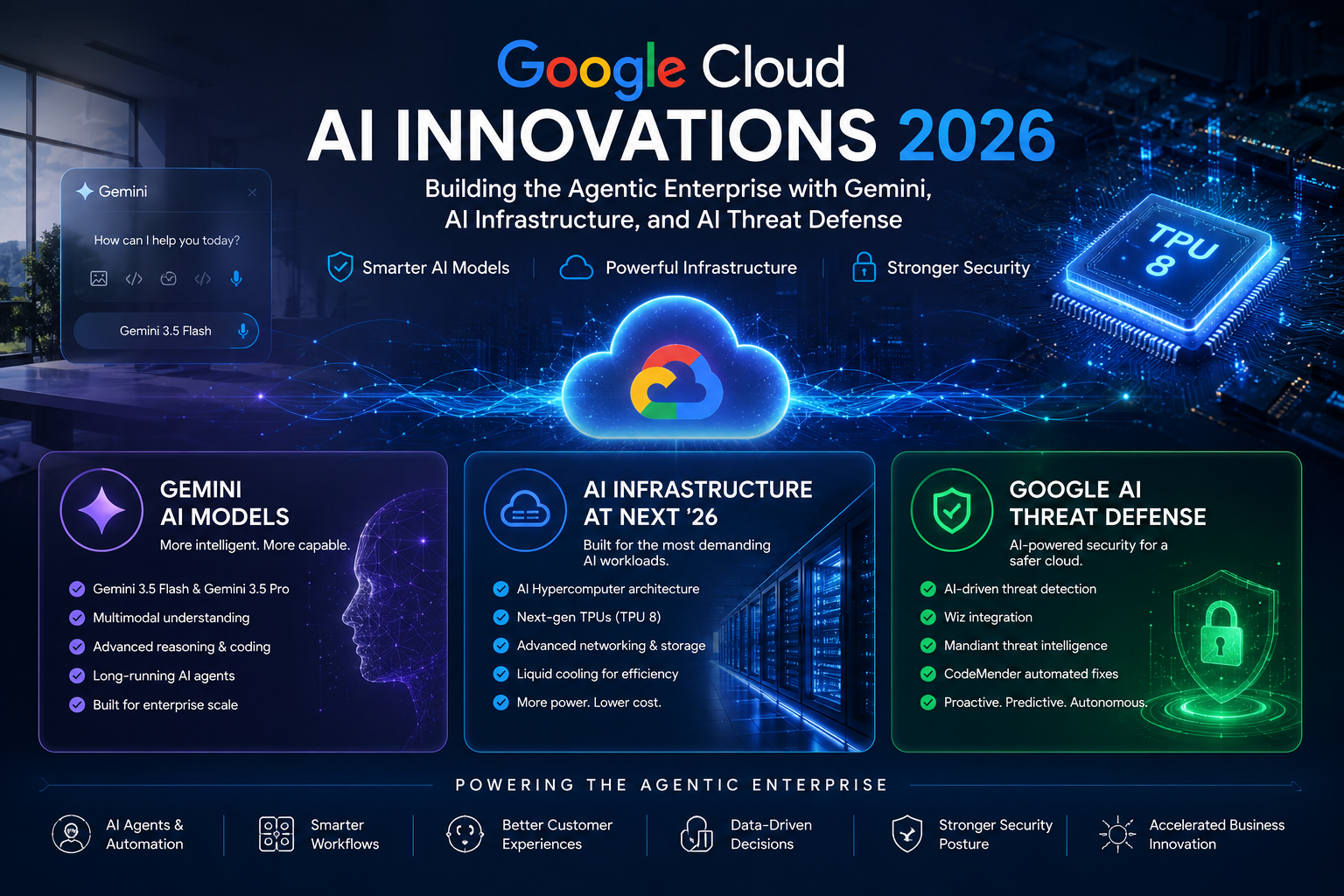
Artificial intelligence is no longer an experimental technology reserved for research labs. In 2026, it has become the driving force behind digital transformation across nearly every industry. Businesses are using AI to automate workflows, improve customer experiences, strengthen cybersecurity, and make smarter decisions using data. Recognizing this shift, Google unveiled a series of major announcements during Google Cloud Next ’26 and Google I/O 2026, introducing new AI models, enterprise platforms, infrastructure upgrades, and security solutions designed to help organizations build what Google calls the “Agentic Enterprise.”
The announcements weren’t just incremental improvements. They represented Google’s vision for the future of enterprise AI—a future where intelligent AI agents work alongside employees, infrastructure is purpose-built for large-scale AI workloads, and cybersecurity becomes autonomous enough to keep pace with increasingly sophisticated threats. From the launch of Gemini 3.5 Flash and Gemini Omni to the introduction of Google AI Threat Defense, Google Cloud is positioning itself as a complete AI ecosystem rather than simply a cloud provider.
This article explores the most important Google Cloud AI innovations announced in 2026, explains how they work, and examines what they mean for developers, enterprises, and the future of cloud computing.

Why Google Cloud Is Focusing on the “Agentic Enterprise”
Google’s central message throughout its 2026 announcements is that businesses are entering the agentic era. Instead of using AI merely as a chatbot or search assistant, organizations are beginning to deploy intelligent AI agents capable of completing complex tasks autonomously. These agents can analyze information, execute workflows, generate code, summarize documents, interact with enterprise systems, and even collaborate with other AI agents under human supervision.
To support this transformation, Google Cloud is investing across the entire AI stack. Rather than providing isolated AI tools, the company is integrating advanced language models, cloud infrastructure, developer platforms, enterprise applications, and cybersecurity into a single ecosystem. According to Google Cloud, nearly 75% of its customers are already using AI products, and customer demand continues to grow rapidly.

Gemini 3.5: Google’s Next-Generation AI Model
One of the biggest highlights from Google I/O 2026 was the introduction of Gemini 3.5 Flash, the latest member of Google’s Gemini family of foundation models. Google describes it as a model that combines advanced reasoning with faster performance, making it particularly suitable for coding, long-running AI agents, and enterprise applications. Google also announced that Gemini 3.5 Pro is in testing for even more demanding workloads.
Unlike previous generations of AI, Gemini 3.5 is designed to understand text, code, images, audio, and structured business data within a unified model. This multimodal capability enables enterprises to build applications that can process diverse types of information without relying on multiple disconnected AI systems.
For software developers, Gemini 3.5 can assist with writing code, debugging applications, explaining complex functions, and generating documentation. For business users, it powers intelligent assistants capable of summarizing meetings, analyzing reports, automating repetitive tasks, and improving workplace productivity.

Gemini Omni Brings AI-Powered Video Creation to Enterprises
Google also introduced Gemini Omni, a new multimodal model focused on creating and editing video using natural language. Instead of requiring specialized editing software or manual production workflows, Gemini Omni allows users to generate or modify videos using combinations of text, images, audio, and existing video content.
This technology has significant implications for industries such as marketing, education, retail, and media. Businesses can create product demonstrations, training materials, personalized marketing campaigns, and promotional videos much faster than traditional production methods. By reducing the technical barriers to video creation, Google aims to make high-quality visual content accessible to organizations of all sizes.

Gemini Spark: Your Personal Enterprise AI Assistant
Another notable announcement was Gemini Spark, described by Google as a 24/7 personal AI agent for enterprise users. Unlike conventional virtual assistants that simply answer questions, Gemini Spark is designed to perform multi-step tasks autonomously while remaining under user control.
For example, users can assign recurring tasks, automate document preparation, summarize emails, gather information from connected business applications, and receive updates without manually initiating every action. Spark integrates with Google Workspace and several enterprise applications while operating inside Google Cloud’s managed security environment.
Google emphasizes that Spark runs within isolated cloud environments and requires user approval for sensitive actions, helping organizations balance automation with governance and security.

Google Antigravity Makes AI Development Easier
Google also expanded Google Antigravity, its platform for building AI-powered applications. The latest version introduces enterprise-grade security, compliance features, and a standalone desktop application that enables developers to orchestrate AI agents more efficiently.
One of the most interesting additions is the Managed Agents API, which allows developers to deploy AI agents in secure Google-hosted environments without managing complex infrastructure. Instead of configuring servers, runtime environments, and security controls manually, developers can focus on designing intelligent agent behavior while Google handles the underlying platform.
This significantly reduces development complexity and accelerates enterprise AI adoption.

AI Infrastructure Built for Massive Enterprise Workloads
Artificial intelligence requires enormous computing power. Large language models, multimodal systems, and enterprise AI agents process billions of data points every day. To support this demand, Google announced significant investments in AI infrastructure during Cloud Next ’26.
Among the key announcements were new generations of Tensor Processing Units (TPUs), purpose-built hardware optimized for training and running AI models more efficiently than traditional processors. Google also highlighted improvements in networking, storage, and cloud architecture that allow businesses to scale AI workloads while controlling costs.
Rather than treating infrastructure as a background service, Google now considers AI infrastructure a strategic advantage. By co-designing hardware and software, Google aims to deliver faster AI performance with greater energy efficiency and lower operational expenses.

Building the Agentic Enterprise with Google Cloud
A recurring theme across Google’s announcements is the concept of the Agentic Enterprise. In this vision, AI agents are integrated throughout an organization, helping employees perform complex work rather than replacing them.
Potential enterprise use cases include:
- Automating customer support requests.
- Generating financial reports.
- Managing IT operations.
- Summarizing business meetings.
- Assisting software developers.
- Supporting HR processes.
- Accelerating research projects.
- Managing enterprise knowledge bases.
Instead of interacting with isolated chatbots, employees collaborate with intelligent AI agents capable of understanding organizational context and completing tasks across multiple business systems.

Google AI Threat Defense: Fighting AI with AI
While AI creates new opportunities, it also introduces new security challenges. Cybercriminals increasingly use artificial intelligence to identify vulnerabilities, automate attacks, and exploit systems faster than human security teams can respond. To address this growing threat, Google introduced Google AI Threat Defense, an AI-powered cybersecurity platform designed to automate vulnerability detection, risk prioritization, and remediation.
Unlike traditional security tools that simply report potential issues, Google AI Threat Defense combines Gemini models, Wiz cloud security capabilities, CodeMender’s automated remediation, and Mandiant’s threat intelligence to help organizations predict attack paths and deploy verified fixes before attackers can exploit vulnerabilities.
Google outlines a four-stage approach:
- Prepare enterprise environments.
- Scan and prioritize vulnerabilities.
- Remediate risks using AI-assisted workflows.
- Continuously monitor for emerging threats.
This proactive model reflects a broader shift toward autonomous cybersecurity, where AI helps defenders respond at machine speed rather than relying solely on manual analysis.

Frequently Asked Questions
What is Google Cloud’s biggest AI announcement in 2026?
The biggest announcements include Gemini 3.5, Gemini Omni, Gemini Spark, Google Antigravity updates, AI infrastructure improvements, and Google AI Threat Defense.
What is the Agentic Enterprise?
It is Google’s vision of organizations where AI agents actively assist employees by automating workflows and completing complex tasks securely.
What is Google AI Threat Defense?
It is an AI-powered cybersecurity platform that helps organizations detect, prioritize, and remediate vulnerabilities using Gemini, Wiz, CodeMender, and Mandiant technologies.
How does Gemini 3.5 improve enterprise AI?
Gemini 3.5 offers stronger reasoning, coding, multimodal understanding, and support for long-running AI agents, enabling more capable enterprise applications.
Conclusion
Google Cloud’s 2026 announcements mark a significant step toward the next generation of enterprise computing. By combining powerful Gemini models, purpose-built AI infrastructure, intelligent development platforms, and AI-driven cybersecurity, Google is creating a comprehensive ecosystem designed for the agentic era. Businesses that embrace these innovations can automate operations, enhance productivity, strengthen security, and accelerate digital transformation while maintaining the governance and scalability required for enterprise environments. As AI continues to evolve, Google Cloud’s integrated approach positions it as one of the leading platforms for organizations looking to build the future with artificial intelligence.