
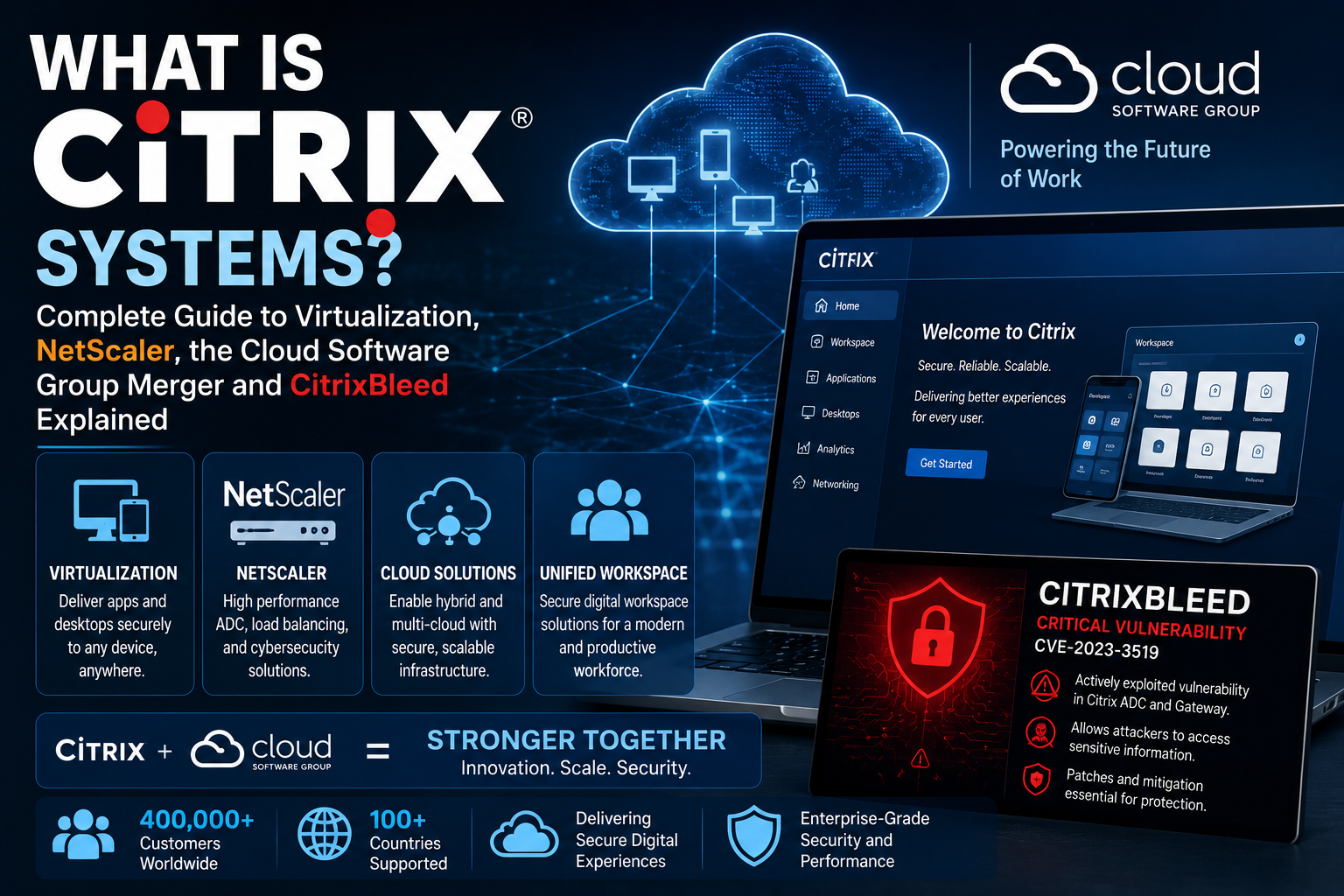
What is Citrix Systems? Complete Guide to Virtualization, NetScaler, the Cloud Software Group Merger and CitrixBleed Explained
If you work in IT, remote access, or enterprise software, you’ve almost certainly heard of Citrix. Whether you’re searching “what is Citrix used for,” “is Citrix still a company,” or “CitrixBleed vulnerability explained,” this article covers everything you need to know about one of the most influential names in enterprise virtualization and remote access technology.
What is Citrix Systems?
Citrix Systems is a technology company best known for pioneering desktop and application virtualization, allowing employees to securely access their work computers, applications, and files from virtually any device, anywhere in the world. For decades, Citrix has been a core part of enterprise IT infrastructure, especially for large organizations that need secure remote access at scale.
At its peak as a public company, Citrix products were reportedly used by over 400,000 organizations worldwide, including the vast majority of Fortune 100 and Fortune 500 companies. Today, Citrix continues to operate as one of the flagship brands under a larger parent company called Cloud Software Group.

The History of Citrix Systems
Citrix Systems was founded in 1989 by Ed Iacobucci, a former IBM engineer, with a vision of making remote computing accessible before “remote work” was even a common phrase. Over the following decades, Citrix became a dominant force in desktop virtualization through products like XenApp and XenDesktop, which let businesses deliver full desktop environments to employees over the internet.
Citrix’s importance skyrocketed during the COVID-19 pandemic, when the sudden global shift to remote work made secure virtual desktop technology essential for millions of businesses almost overnight.
In January 2022, Citrix was acquired in a $16.5 billion deal by affiliates of Vista Equity Partners and Evergreen Coast Capital. As part of this deal, Citrix was merged with TIBCO Software, another Vista-owned company, forming a new parent entity called Cloud Software Group. Following the merger, Citrix was taken private and delisted from the Nasdaq, meaning it no longer publicly reports quarterly earnings.
What Does Citrix Actually Do?
Citrix’s core technology revolves around a few key areas:
1. Virtual Apps and Desktops
This flagship offering (formerly known as XenApp and XenDesktop) allows organizations to host applications and full desktop environments in a data center or the cloud, streaming them securely to employee devices — regardless of the operating system or hardware being used.
2. NetScaler (Application Delivery and Load Balancing)
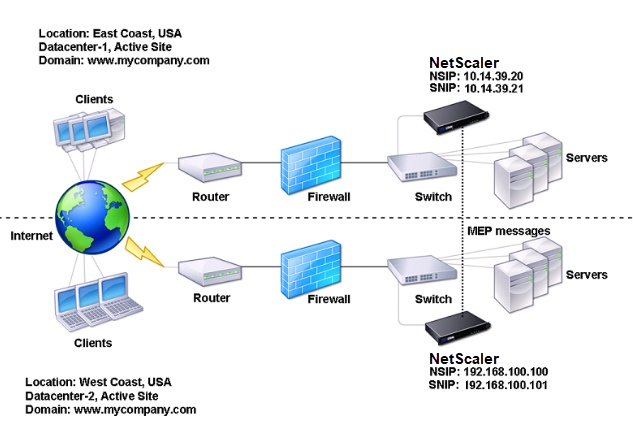
NetScaler, one of Citrix’s most widely deployed products, manages application traffic, load balancing, and secure remote access through VPN gateways. It plays a critical role in helping enterprise applications run reliably and securely at scale.
3. ShareFile
A secure file-sharing and content collaboration platform designed for regulated industries such as healthcare, legal, and finance, where compliance and data security are critical.
4. Workspace and Digital Workspace Technology
Citrix Workspace unifies access to apps, desktops, and files into a single secure portal, giving employees a consistent experience across devices while giving IT teams centralized control and security policies.
The CitrixBleed Vulnerability — A Major Security Wake-Up Call
No discussion of Citrix would be complete without addressing CitrixBleed (CVE-2023-4966), one of the most significant cybersecurity incidents tied to the company’s products.
In October 2023, Citrix disclosed a critical vulnerability affecting its NetScaler ADC and NetScaler Gateway products — the very tools thousands of organizations rely on for secure remote access. The flaw allowed unauthenticated attackers to extract session tokens directly from a device’s memory, effectively letting hackers hijack legitimate user sessions without needing a password or multi-factor authentication.
Lessons From the CitrixBleed Incident
CitrixBleed served as a stark reminder that the very infrastructure designed to enable secure remote access can itself become a prime target for attackers. It highlighted the importance of prompt patching, proper session invalidation after updates, and continuous monitoring — lessons that have since shaped best practices across the broader network security industry.
Citrix vs Other Virtualization and Remote Access Providers
Citrix is often compared to competitors like VMware (Omnissa), Microsoft Azure Virtual Desktop, and Parallels. While competitors have grown rapidly in cloud-native virtual desktop offerings, Citrix’s decades of enterprise relationships and its NetScaler application delivery technology continue to give it a strong foothold, particularly among large, security-conscious organizations.
Conclusion
From its founding in 1989 to becoming a cornerstone of remote work during the pandemic, and later navigating a major private equity buyout and a high-profile security crisis, Citrix’s journey reflects the broader evolution of enterprise IT itself. As part of Cloud Software Group, Citrix continues to power secure access for organizations around the world, while the CitrixBleed episode stands as an important reminder of how critical — and how targeted — remote access infrastructure has become in today’s threat landscape.