
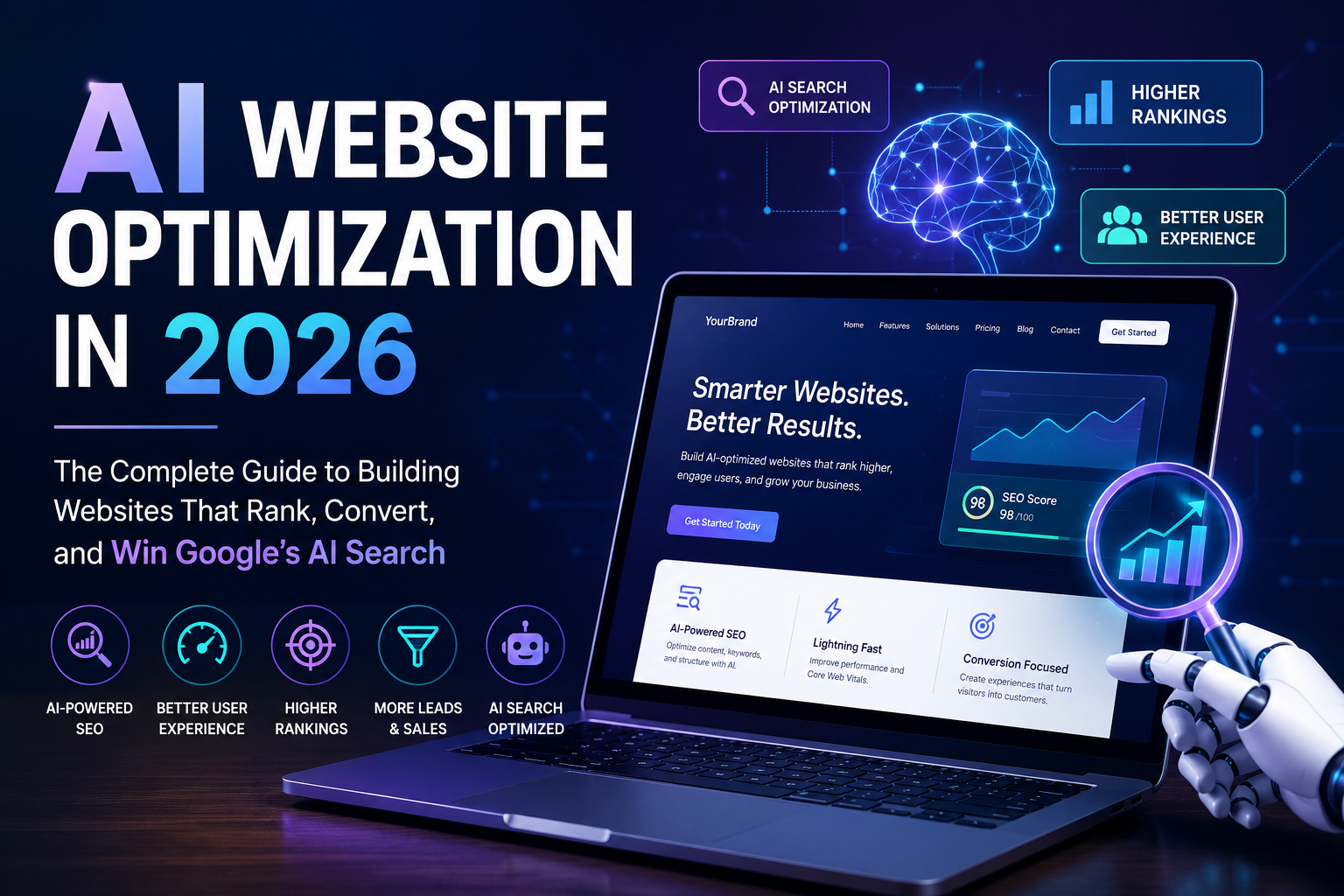
The way people discover websites is changing faster than ever. For years, businesses focused on traditional SEO techniques such as keyword optimization, backlinks, and technical improvements to attract visitors from search engines. While these strategies still matter, the rise of artificial intelligence has fundamentally transformed how websites are ranked, recommended, and experienced.
Today’s users increasingly rely on AI-powered search experiences like Google AI Overviews, AI assistants, and conversational search engines that summarize information instead of simply displaying a list of links. This shift means businesses must optimize not only for search engine crawlers but also for AI systems that evaluate content quality, expertise, trustworthiness, and user value.

Why AI Website Optimization Matters More Than Traditional SEO
Search engine optimization has always been about helping search engines understand your content. However, AI-powered search goes much further. Instead of matching keywords, AI analyzes meaning, context, authority, user intent, and the overall usefulness of a page.
For example, when someone searches for “best CRM software for small businesses,” AI-powered search engines may compare multiple trusted sources, summarize key features, evaluate customer reviews, and recommend the most relevant options. Websites that provide comprehensive, well-structured, and trustworthy information have a greater chance of being featured in these AI-generated responses.
This evolution has changed the goal of SEO. Ranking on the first page is still valuable, but appearing in AI summaries, featured snippets, and conversational search results can significantly increase brand visibility and credibility.
Businesses that continue relying solely on outdated keyword-stuffing techniques are likely to struggle as AI becomes better at identifying genuinely helpful content.

What Is AI Website Optimization?
AI website optimization refers to the process of improving a website using artificial intelligence technologies while also making the website easier for AI-powered search engines to understand and recommend.
It combines several disciplines, including:
- Search engine optimization (SEO)
- User experience (UX)
- Content marketing
- Website performance optimization
- Conversion rate optimization (CRO)
- Personalization
- Data analytics
- Automation
Rather than focusing on a single ranking factor, AI website optimization takes a holistic approach. Every page, image, heading, internal link, and user interaction contributes to how AI systems evaluate the overall quality of a website.
Modern AI tools can also help businesses identify content gaps, generate optimization recommendations, predict user behavior, automate repetitive SEO tasks, and improve customer engagement through personalized experiences.

How AI Is Changing Google Search
Google’s search engine has become increasingly intelligent over the past decade, but recent advancements in generative AI represent one of the biggest shifts in search history.
Instead of displaying only traditional search results, Google now provides AI-generated summaries that answer complex questions directly. These responses are built by analyzing multiple authoritative sources and presenting concise, context-rich answers.
For website owners, this means creating content that demonstrates expertise rather than simply targeting keywords.
Some of the key ranking signals becoming increasingly important include:

Topical Authority
Google favors websites that consistently publish high-quality content around a specific subject instead of producing isolated articles on unrelated topics.
For example, a company that publishes detailed guides on AI, cloud computing, automation, cybersecurity, and enterprise software is more likely to establish authority than a website covering random topics.

Content Depth
AI systems evaluate whether an article thoroughly answers a user’s question.
Comprehensive content generally performs better than short, superficial articles because it addresses multiple aspects of a topic, answers follow-up questions, and provides actionable insights.
User Experience
Search engines increasingly measure how users interact with websites.
Important factors include:
- Fast loading speed
- Mobile responsiveness
- Easy navigation
- Readable formatting
- Helpful visuals
- Clear page structure
A positive user experience encourages visitors to stay longer, explore additional pages, and engage with your content—all of which can contribute to stronger search performance.

Building an AI-Friendly Website Architecture
A well-organized website benefits both users and AI systems.
Instead of creating isolated pages, businesses should develop interconnected content clusters around core topics.
For example, if your website focuses on AI software, your content could include:
- AI Website Optimization
- AI SEO Tools
- Enterprise AI Platforms
- AI Marketing Automation
- AI Chatbots
- AI Analytics
- AI Website Builders
Each article links naturally to related content, creating a strong topical network that helps search engines understand your expertise.
This approach not only improves SEO but also keeps visitors engaged by encouraging them to explore additional resources.

Why High-Quality Content Still Wins
Artificial intelligence has made content creation faster than ever, but speed should never replace quality.
Many businesses now publish hundreds of AI-generated articles with little editing or originality. While this may increase content volume, it rarely builds trust or long-term rankings.
Successful websites use AI as a productivity tool rather than a replacement for human expertise.
The best-performing content combines:
- Original insights
- Real-world examples
- Industry expertise
- Clear explanations
- Accurate information
- Practical advice
This balance helps establish credibility while providing readers with genuine value.
Personalization Is Becoming a Competitive Advantage
AI allows websites to deliver personalized experiences based on visitor behavior, preferences, and intent.
Instead of showing identical content to every visitor, businesses can dynamically recommend relevant products, articles, or services.
For example:
- Returning visitors may see recently viewed products.
- Enterprise customers can receive industry-specific case studies.
- New users may receive educational content.
- Existing customers can access personalized dashboards.
Personalization improves user satisfaction while increasing engagement, lead generation, and conversion rates.

AI-Powered Analytics Drive Smarter Decisions
Traditional analytics show what happened.
AI analytics help explain why it happened and predict what may happen next.
Modern AI platforms can identify trends, detect unusual behavior, forecast customer demand, recommend optimization opportunities, and even automate reports for marketing teams.
Instead of manually reviewing dozens of dashboards, businesses receive actionable insights that support faster and more informed decision-making.
The Rise of AI Search Optimization
Optimizing for AI search involves more than ranking for keywords.
Businesses should focus on answering complete questions, providing trustworthy information, structuring content with clear headings, and covering topics comprehensively.
Articles that demonstrate expertise, experience, authority, and trustworthiness are increasingly favored by AI systems because they provide better user outcomes.

Essential AI Tools for Website Optimization
A successful AI website strategy often combines several specialized tools.
- ChatGPT for content planning and drafting.
- Google Search Console to monitor search performance.
- Google Analytics 4 for user behavior insights.
- Semrush or Ahrefs for keyword research and backlink analysis.
- Surfer SEO or Clearscope for on-page optimization.
- Webflow or other modern CMS platforms for fast, responsive websites.
The goal is to use AI to enhance your workflow—not replace thoughtful strategy and human expertise.
Common Mistakes to Avoid
Many businesses adopt AI but overlook the fundamentals.
Avoid these common errors:
- Publishing AI-generated content without editing.
- Ignoring EEAT (Experience, Expertise, Authoritativeness, and Trustworthiness).
- Writing only for keywords instead of user intent.
- Neglecting technical SEO and website speed.
- Failing to update outdated articles.
- Using weak internal linking.
High-quality, trustworthy content consistently outperforms mass-produced articles.

The Future of AI Website Optimization
AI will continue to change how people discover information online. Websites that succeed in the coming years will be those that combine strong technical foundations with authoritative content and excellent user experiences.
Future trends include:
- More personalized search results.
- AI-powered shopping assistants.
- Voice and conversational search.
- Predictive content recommendations.
- Greater emphasis on first-hand expertise and trustworthy information.
Businesses that adapt early will be better positioned to attract organic traffic and build lasting customer relationships.

Frequently Asked Questions
What is AI website optimization?
AI website optimization is the process of improving a website using artificial intelligence tools and best practices to enhance SEO, user experience, and conversions.
Does AI replace traditional SEO?
No. AI complements SEO by helping create better content, analyze data, and automate tasks, while core SEO principles remain essential.
Can AI-generated content rank on Google?
Yes, if it is accurate, original, helpful, and reviewed by humans. Quality matters more than how the content is created.
Which industries benefit most from AI website optimization?
SaaS, fintech, healthcare, eCommerce, legal, cybersecurity, education, and B2B businesses can all benefit significantly.
Conclusion
AI website optimization is no longer just a competitive advantage—it has become a necessity. As Google and other search platforms increasingly rely on AI to evaluate and present information, businesses must focus on creating websites that are fast, trustworthy, user-friendly, and rich in valuable content.
Rather than relying on outdated SEO tactics, successful brands are using AI to improve content quality, personalize customer experiences, automate repetitive tasks, and make data-driven decisions. Combined with strong technical SEO and a clear content strategy, AI can help businesses attract more qualified traffic, increase conversions, and build long-term authority in their industry.
By investing in AI website optimization today, you’re not just preparing for the future of search—you’re building a website that’s ready to perform in an AI-first digital world.