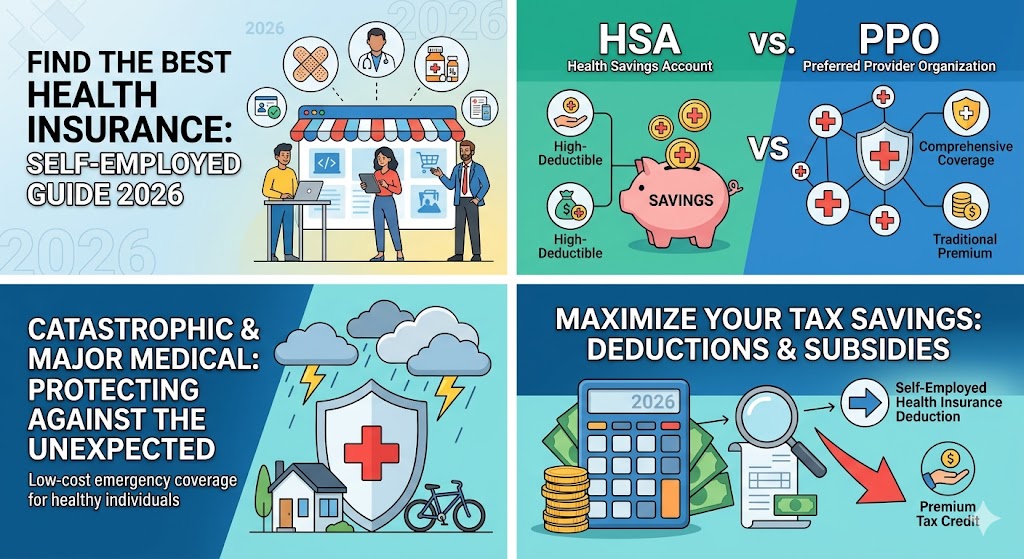
Freelancers, solopreneurs, and independent contractors — here’s everything you need to find affordable, comprehensive health coverage in 2026 and never overpay again.
The good news: self-employed people in 2026 have more health insurance options than ever before — and thanks to enhanced subsidies from the Affordable Care Act, millions of freelancers and independent contractors are qualifying for coverage far more affordable than they realize. This guide cuts through the noise and gives you a clear roadmap to the best health insurance plans for self-employed workers — based on your income, health needs, and budget.
📋 Table of Contents
- Why Health Insurance Is Tricky for the Self-Employed
- Your 7 Health Insurance Options Compared
- ACA Marketplace Plans — The #1 Option for Most
- HSA + High-Deductible Plans — Save Thousands
- Best Health Insurance Companies for Self-Employed (2026)
- How Much Does Health Insurance Cost When Self-Employed?
- The Self-Employed Health Insurance Tax Deduction
- How to Choose the Right Plan for You
- Step-by-Step: How to Get Covered
- Frequently Asked Questions

Why Health Insurance Is Tricky for the Self-Employed
When you work for an employer, health insurance feels almost invisible — it’s deducted from your paycheck, your company covers 50–80% of the premium, and HR handles everything. Going self-employed strips all of that away instantly.
Suddenly you’re both the employee and the employer. You pay 100% of your premium. You navigate plan types (HMO, PPO, HDHP, EPO). You deal with open enrollment windows, special enrollment periods, and — if you make a mistake — potential gaps in coverage that leave you financially exposed to catastrophic medical bills.
Here’s the critical mindset shift: yes, you pay more upfront as a self-employed person. But the 100% tax deduction on premiums (available to self-employed individuals whether you itemize or not) significantly reduces your real out-of-pocket cost. If you’re in the 22% tax bracket paying $600/month in premiums, your effective cost after the deduction is closer to $468/month — and ACA subsidies can reduce it even further.
Unlike employees, self-employed individuals can deduct 100% of health insurance premiums directly from their gross income — not just as an itemized deduction. This above-the-line deduction reduces your adjusted gross income, which may also increase your ACA subsidy eligibility. It’s a powerful double benefit that employed workers don’t get.
Your 7 Health Insurance Options Compared
Before diving into specific plans and companies, you need to know what types of coverage are available to self-employed people. Each option has different costs, flexibility, and health requirements.
ACA Marketplace Plans
Open to everyone. Subsidies available based on income. Four metal tiers. Best for most self-employed people.
⭐ Most Popular
HSA + HDHP
High-deductible plan paired with a tax-free Health Savings Account. Ideal for healthy, low-usage individuals.
Tax Savings
Health Share Plans
Faith-based or community cost-sharing. Not insurance — members share each other’s medical bills.
Lower Cost
COBRA Continuation
Keep your former employer’s plan for up to 18 months. You pay full premium + 2% admin fee. Expensive.
Short-Term
Spouse/Partner Plan
If your spouse has employer coverage, joining their plan is often the most affordable option available.
Best Value
Association Health Plans
Join a professional or trade association offering group-rate coverage. NASE, Freelancers Union, etc.
Group Rates
Medicaid / CHIP
Free or very low-cost coverage if your income is below ~138% of the federal poverty level.
Income-Based
ACA Marketplace Plans — The #1 Option for Most Self-Employed People
The Affordable Care Act (ACA) Marketplace — accessible at HealthCare.gov or your state’s exchange — is the single best starting point for the majority of self-employed individuals. Plans are guaranteed issue (no one can be denied for pre-existing conditions), subsidies are available based on income, and you have a wide range of coverage levels to choose from.
Understanding the Four Metal Tiers
ACA plans are organized into four “metal” tiers based on how costs are split between you and your insurer. The tiers don’t reflect quality of care — they determine the cost-sharing structure.
For most self-employed people who qualify for ACA subsidies (Premium Tax Credits), Silver plans offer the best overall value — especially because cost-sharing reductions (CSR) are only available on Silver-tier plans, which can dramatically lower your deductible and out-of-pocket maximum if your income qualifies.
Who Qualifies for ACA Subsidies?
If your estimated 2026 income falls between 100% and 400% of the Federal Poverty Level (FPL), you qualify for Premium Tax Credits that reduce your monthly premium. For a single individual, that’s roughly $14,580 to $58,320 annually. Many self-employed people fluctuate in this range, making marketplace subsidies a crucial benefit to understand and claim.
Your ACA subsidy is based on your net self-employment income (after business deductions), not your gross revenue. This means business expenses, home office deductions, and retirement contributions all reduce your MAGI — potentially increasing your subsidy. Work with a tax professional to optimize this calculation.

HSA + High-Deductible Plans — The Tax-Saving Power Move
Pairing a High-Deductible Health Plan (HDHP) with a Health Savings Account (HSA) is one of the most powerful financial tools available to self-employed people — and it’s massively underused. Here’s why this combination is so effective.
An HSA is a tax-advantaged savings account exclusively for medical expenses. Contributions are tax-deductible, growth is tax-free, and withdrawals for qualified medical expenses are also tax-free. That’s a triple tax benefit that no other account type offers. In 2026, you can contribute up to $4,300 (individual) or $8,550 (family) to an HSA annually.
| Feature | Traditional Plan | HDHP + HSA |
|---|---|---|
| Monthly Premium | $450–$700 | $250–$450 |
| Annual Deductible | $500–$1,500 | $1,600–$3,200 |
| HSA Contribution (tax-free) | ✗ Not eligible | ✓ Up to $4,300 |
| Premium Tax Deduction | ✓ Yes | ✓ Yes |
| Triple Tax Advantage | ✗ No | ✓ Yes |
| Best For | Frequent medical needs | Healthy, infrequent care users |
If you’re generally healthy and don’t anticipate major medical expenses, the HDHP + HSA combination can save you $2,000–$4,000+ per year in premiums and taxes compared to a traditional low-deductible plan. The HSA funds roll over year after year (unlike FSA accounts) and can be invested in mutual funds or ETFs for long-term growth — making it an additional retirement vehicle.
Once you turn 65, you can withdraw HSA funds for any purpose — not just medical — without penalty (though non-medical withdrawals are taxed as ordinary income). This makes an HSA function like a traditional IRA in retirement, on top of all the tax-free medical expense benefits throughout your working years.
Best Health Insurance Companies for Self-Employed (2026)
Not all health insurers are created equal. Coverage availability varies by state, network quality varies by region, and customer service can make or break your experience when you actually need to use your insurance. Here are the top health insurance providers for self-employed individuals based on coverage, value, and customer satisfaction in 2026.
| Provider | Plan Types | ACA Plans | HSA-Eligible | Avg Rating | Best For |
|---|---|---|---|---|---|
| Blue Cross Blue ShieldTop Pick | PPO, HMO, EPO | ✓ | ✓ | 4.4 / 5 | Widest network access |
| UnitedHealthcare | PPO, HMO, HDHP | ✓ | ✓ | 4.2 / 5 | National coverage, telehealth |
| Kaiser PermanenteTop Pick | HMO | ✓ | ✓ | 4.6 / 5 | Integrated care, high satisfaction |
| Aetna (CVS Health) | PPO, HMO, HDHP | ✓ | ✓ | 4.1 / 5 | CVS MinuteClinic access |
| Cigna | PPO, HDHP | ✓ | ✓ | 4.0 / 5 | International & large network |
| Oscar Health | HMO, EPO | ✓ | ✓ | 4.3 / 5 | Tech-first, freelancer-friendly |
| Molina HealthcareBudget | HMO | ✓ | ✗ | 3.8 / 5 | Low-income, subsidy users |
Availability varies significantly by state. Blue Cross Blue Shield and UnitedHealthcare have the broadest national footprints, while Kaiser Permanente is only available in select states (California, Colorado, Georgia, Hawaii, Maryland, Oregon, Virginia, Washington, and DC). Oscar Health is particularly popular with freelancers and gig workers for its digital-first approach and transparent pricing.
Before enrolling in any plan, verify that your preferred doctors, specialists, and hospitals are in-network. An out-of-network specialist visit can cost 3–5x more than an in-network visit — or may not be covered at all under HMO and EPO plans. Use each insurer’s online provider directory tool before signing up.

How Much Does Health Insurance Cost When You’re Self-Employed?
Cost is the number one concern for self-employed people shopping for health insurance — and it varies dramatically based on your age, location, tobacco use, income, and the plan tier you choose. Here’s a realistic breakdown of what you can expect to pay in 2026.
*Estimates for a non-smoker before ACA subsidies. Actual premiums vary by state, insurer, and plan. Source: KFF Health Insurance Marketplace Calculator.
These numbers look daunting — but remember two critical factors. First, ACA subsidies can reduce these premiums by $100–$500+/month depending on your income. Second, 100% of these premiums are tax-deductible as a self-employed person, which reduces your real cost by your effective tax rate. A 40-year-old in the 22% bracket paying $490/month actually has an effective cost of around $382/month after the deduction.
The Self-Employed Health Insurance Tax Deduction — Don’t Leave This Money Behind
This is one of the most valuable and most overlooked tax breaks for freelancers, consultants, and independent contractors. As a self-employed individual, you can deduct 100% of health insurance premiums you pay for yourself, your spouse, and your dependents directly from your adjusted gross income.
This is an above-the-line deduction — meaning you don’t need to itemize your deductions to claim it. You take it directly on Schedule 1 of your Form 1040 (line 17), and it reduces your taxable income dollar-for-dollar. If you pay $6,000/year in premiums and you’re in the 22% federal tax bracket, that’s $1,320 back in your pocket — automatically.
Important limitation: you cannot take this deduction in any month where you were eligible for employer-sponsored health insurance (either through your own employment or your spouse’s). Also, the deduction cannot exceed your net self-employment income — so if you had a loss year, you may not be able to claim the full amount. Consult a CPA who works with self-employed clients to maximize this benefit correctly.
How to Choose the Right Health Insurance Plan
With so many options, choosing the right plan can feel paralyzing. Here’s a simple decision framework based on your health situation and budget.
If You’re Young and Generally Healthy
Start with a Bronze or Silver HDHP plan paired with an HSA. Keep your premium low, maximize HSA contributions, and let the money grow tax-free. You’ll pay more out-of-pocket if you do need care, but statistically you won’t use much of it — and your HSA balance grows into a powerful tax-free asset over time.
If You Have Regular Medical Needs or a Chronic Condition
Choose a Gold or Silver plan with lower deductibles and copays. The higher monthly premium will typically be offset by significantly lower costs when you actually use your insurance. Calculate your expected annual medical costs and compare total out-of-pocket under each tier — not just the monthly premium.
If Your Income Is Variable (Common for Freelancers)
Estimate your income conservatively when enrolling — if you earn less than expected, your subsidy adjusts at tax time. If you earn more, you may owe some subsidy back. Consider reporting life changes (income fluctuations) to the marketplace mid-year to adjust your subsidy in real time and avoid a large tax bill in April.
If You Have a Family to Cover
Compare family plans on the marketplace vs. adding family members to an individual plan separately. Sometimes insuring a spouse and children separately — especially if their income levels differ — can result in different subsidy calculations and lower total costs. Run both scenarios through HealthCare.gov’s calculator before deciding.
Step-by-Step: How to Get Health Coverage as a Self-Employed Person
-
1Estimate Your Annual Net IncomeYour ACA subsidy is based on your Modified Adjusted Gross Income (MAGI) — your net self-employment income after deductions. Use last year’s Schedule C as a baseline and adjust for this year’s projected revenue and expenses. Be conservative but realistic.
-
2Check Subsidy Eligibility at HealthCare.govUse the official marketplace calculator to see exactly what subsidies you qualify for at your projected income level. Many self-employed people are shocked to discover they qualify for $200–$500/month in Premium Tax Credits that make comprehensive coverage genuinely affordable.
-
3Enroll During Open Enrollment (Nov 1 – Jan 15)The annual Open Enrollment Period for ACA marketplace plans runs November 1 through January 15 in most states. If you miss this window, you’ll need a qualifying life event (job loss, marriage, new baby, moving) to trigger a Special Enrollment Period — otherwise you wait until the next open enrollment.
-
4Compare At Least 3 Plans Side-by-SideDon’t just look at monthly premiums. Compare deductibles, out-of-pocket maximums, copays, coinsurance, and prescription drug formularies. The marketplace allows you to compare up to 3 plans simultaneously. Also verify your current doctors and any needed prescriptions are covered before enrolling.
-
5Open an HSA If Choosing an HDHPOnce enrolled in an HSA-eligible HDHP, open an HSA account immediately. Many banks and credit unions offer HSAs — or use dedicated providers like Fidelity, Lively, or HealthEquity which offer investment options for your HSA balance. Start contributing as much as you can afford — the tax savings are immediate.
-
6Report Income Changes Mid-YearIf your self-employment income changes significantly during the year, log back into the marketplace and update your estimated income. This adjusts your subsidy in real time and prevents either overpaying or owing a large subsidy repayment at tax time. Income fluctuation is normal for the self-employed — the marketplace is designed to accommodate it.
-
7Claim Your Tax DeductionAt tax time, claim your self-employed health insurance deduction on Schedule 1, Line 17 of Form 1040. Include premiums for yourself, your spouse, and dependents. Don’t forget dental and vision premiums also qualify. Keep all premium payment records and your insurance card as documentation.
Ready to Find Your Best Health Insurance Plan?
Compare personalized ACA marketplace plans in minutes — and find out exactly what subsidies you qualify for based on your income.

Frequently Asked Questions
Yes — self-employed individuals can deduct 100% of health insurance premiums (for themselves, spouses, and dependents) as an above-the-line deduction on their federal tax return. This reduces your adjusted gross income directly, without needing to itemize. The deduction cannot exceed your net self-employment income and cannot be claimed in months when you had access to employer-sponsored coverage.
The best option depends on your income, health needs, and location. For most self-employed individuals, ACA Marketplace plans (especially Silver tier) offer the best combination of coverage and affordability — particularly when subsidies are applied. Healthy individuals with lower medical needs often benefit from pairing a Bronze HDHP with a Health Savings Account. Always compare at least 3 plans side-by-side before enrolling.
Without subsidies, individual premiums range from roughly $210/month (age 25, Bronze) to $720+/month (age 55, Gold) depending on age, location, and plan tier. With ACA Premium Tax Credits, many self-employed people pay significantly less — sometimes $0/month for Bronze plans at lower income levels. After the self-employed tax deduction, your effective cost is further reduced by your tax rate.
Report income changes on HealthCare.gov or your state marketplace as soon as they happen. If you earn more than estimated, your subsidy may be reduced and you could owe the difference at tax time. If you earn less, you may be entitled to additional credits. Keeping your income estimate current prevents large surprises at tax filing time — something especially important for freelancers with variable income.
Yes. Losing employer-sponsored health coverage (including when you leave a job to go self-employed) is a qualifying life event that triggers a 60-day Special Enrollment Period. During this window, you can enroll in any ACA Marketplace plan just as you would during Open Enrollment. Don’t wait — once the 60-day window closes, you must wait until the next Open Enrollment Period.
COBRA lets you keep your former employer’s plan for up to 18 months, but you pay the full premium (both employee and employer shares) plus a 2% administrative fee. This typically runs $600–$1,800/month for an individual. COBRA is rarely the most cost-effective option — ACA marketplace plans with subsidies are almost always cheaper for self-employed individuals. Use COBRA only if you need to keep specific doctors mid-treatment or while you comparison-shop marketplace plans.
Health sharing ministries are not traditional insurance. Members contribute monthly and share each other’s medical bills. Monthly costs are often lower ($150–$400/month), but these plans don’t cover pre-existing conditions, have contribution limits, are not ACA-compliant, and do not qualify for the self-employed health insurance tax deduction. They’re a last resort for healthy individuals who can’t afford marketplace premiums even with subsidies — not a mainstream recommendation.
Topics covered in this guide:
Final Thoughts: Health Coverage Is Non-Negotiable
Being uninsured as a self-employed person is a financial risk no business owner should take. A single emergency room visit can cost $5,000–$30,000. A serious illness or surgery without insurance can wipe out years of savings and business growth in a matter of weeks. Health insurance isn’t an optional expense — it’s a foundational part of your business and personal financial plan.
The good news is that with the ACA marketplace, enhanced subsidies, the self-employed tax deduction, and smart HSA strategies, quality health coverage is more accessible and affordable for self-employed people than it’s ever been. Start with HealthCare.gov, estimate your income honestly, compare at least three plans, and work with a tax professional to maximize your deduction.
Your health is your most valuable business asset. Protect it.
✔ ACA Marketplace plans are the #1 option for most self-employed people. ✔ Always apply for subsidies — even moderate incomes often qualify. ✔ Deduct 100% of premiums above-the-line at tax time. ✔ HDHP + HSA is a powerful tax-saving combo for healthy individuals. ✔ Kaiser Permanente leads in customer satisfaction; Oscar is best for digital-first freelancers. ✔ Never go uninsured — one medical event can cost more than years of premiums.
📢 This article is for informational purposes only and does not constitute medical, legal, or financial advice. Consult a licensed insurance broker or health insurance navigator for personalized guidance.
© 2026 · Last updated June 21, 2026 · Share this guide to help other freelancers find affordable coverage